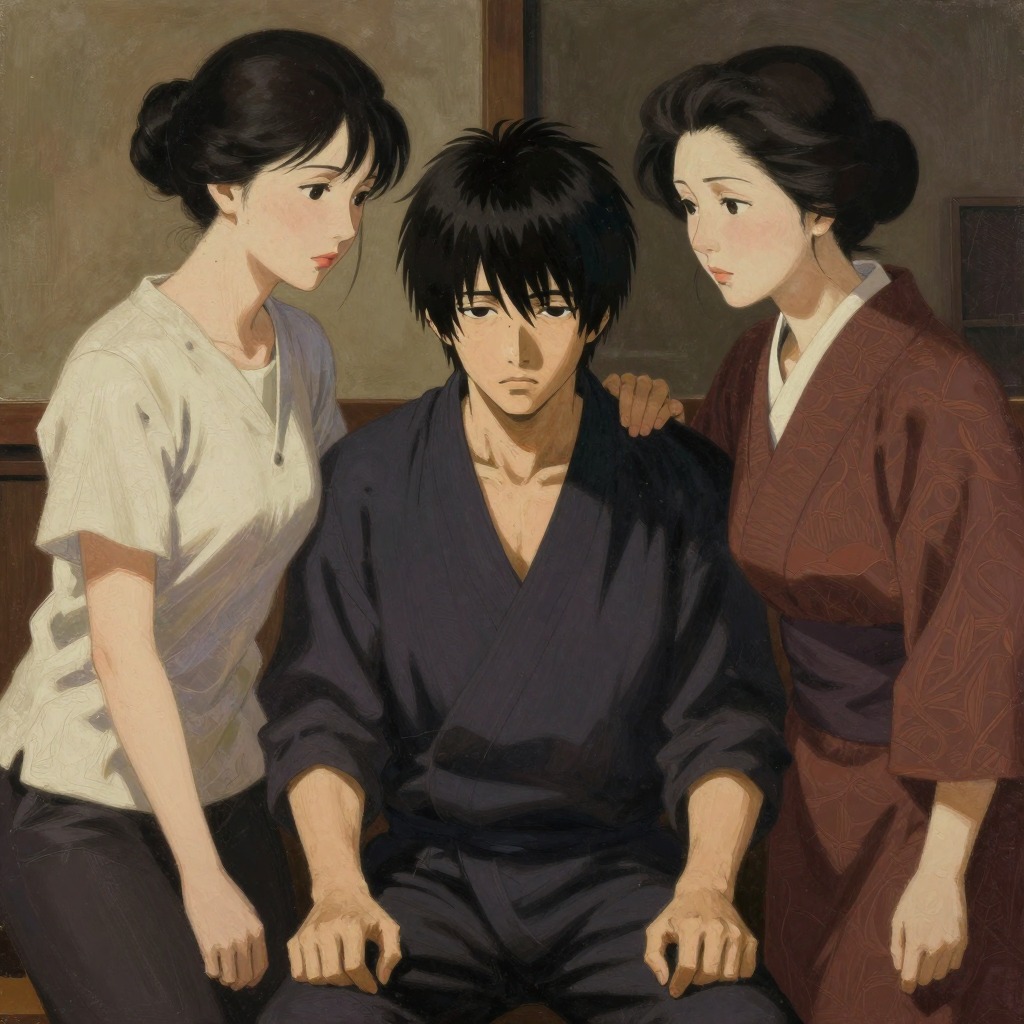
The Halo of Mary
The Halo of Mary is a religious image that appears in Yozo's first notebook as he reflects on his encounters with prostitutes during his student days in Tokyo. It condenses his most contradictory feelings about women and about human connection itself: the women he considers the lowest of the low—imbeciles, lunatics, social refuse—are precisely the ones in whose arms he finds a peace so complete that he can compare it to the presence of the Virgin Mary.
The Image and Its Context
The phrase occurs in the First Notebook, when Yozo describes his habit of visiting prostitutes as a means of escaping his chronic dread of human beings. He writes that he could never think of prostitutes as human beings or even as women; they seemed to him like imbeciles or lunatics. Yet in their arms he felt absolute security and could sleep soundly. He was struck by how utterly devoid of greed they really were, and by the natural friendliness they showed him—a friendliness with no ulterior motive, stripped of high-pressure salesmanship, offered to someone who might never come again. It is at this point that the image appears: "Some nights I saw these imbecile, lunatic prostitutes with the halo of Mary." The juxtaposition is deliberately shocking. The halo, a traditional attribute of the Virgin Mary in Christian iconography, signifies purity, grace, and divine favor. By placing it on women he has just called imbeciles and lunatics, Yozo inverts every conventional moral and aesthetic category. The halo does not sanctify the prostitutes because they are virtuous; it sanctifies them because, in their very degradation and exclusion from respectable society, they offer him a love that is entirely without demand.
The Halo as a Counter-Image to Yozo's World
The Halo of Mary stands in stark opposition to the other dominant images of Yozo's childhood and youth. The family dining room, where ten people ate in gloomy silence, was a place of ritualized dread; the meals felt like acts of prayer to propitiate lurking spirits. The "ghost pictures" he painted after Takeichi showed him van Gogh's self-portrait were attempts to depict the monsters he saw in human beings. The photographs of himself that open the novel—the ugly smirk of the child, the artificial smile of the student, the expressionless face of the older man—are all records of a self that has been disqualified from humanity. Against this landscape of fear, falseness, and emptiness, the Halo of Mary offers a momentary glimpse of something entirely different: a relationship stripped of pretense, calculation, and the threat of betrayal. The prostitutes do not judge him, do not expect him to perform his clowning, do not demand that he be a proper human being. In their arms he is allowed simply to exist, and that permission feels like grace.
The Halo and the Failure of Other Forms of Love
The image gains its full force when set against the other women in Yozo's life. The landlord's daughter, the comrade from the teacher's training college, and even Tsuneko, the woman with whom he attempts suicide, all eventually become sources of anxiety and obligation. Tsuneko, whom he calls the only person he ever loved, is also the woman whose poverty-stricken appearance makes him feel a humiliating pity. Shizuko, the journalist who takes him in after he runs away from Flatfish, becomes a keeper whose kindness he repays by pawning her clothes. Yoshiko, the virgin he marries in the hope of finding "that great savage joy," is violated by a shopkeeper, and the defilement of her trustfulness destroys whatever peace Yozo had begun to feel. In every case, love turns into a trap. The prostitutes alone remain outside this pattern because they expect nothing. The Halo of Mary is the sign of that exception: a love that is given freely and forgotten immediately, a love that leaves no debt.
The Halo and Yozo's Religious Sensibility
Yozo's relationship with religion is entirely negative. He writes that he was frightened even by God, that he could not believe in His love, only in His punishment. Faith, he says, is the act of facing the tribunal of justice with one's head bowed to receive the scourge of God. He can believe in hell but not in heaven. The Halo of Mary is therefore not an expression of orthodox Christian faith; it is a desperate, almost heretical, reappropriation of a sacred symbol to describe an experience that has no place in the moral universe he knows. The prostitutes are not Mary, and Yozo knows it. But in the moment of seeing them with the halo, he is able to feel that something like grace exists in the world, even if it is found in the most unlikely place. The image is a flash of transcendence in a life that otherwise knows only immanence and decay.
The Halo's Fate in the Narrative
The Halo of Mary does not recur as a phrase after the First Notebook. Its disappearance is part of the larger pattern of Yozo's decline. The prostitutes themselves lose their power to comfort him once Horiki points out that he has acquired the odor of a "lady-killer" and that women instinctively flock to him. The knowledge that his own atmosphere is drawing women to him turns the prostitutes from safe havens into another source of shame. The halo fades, and what remains is the toad—the image Yozo uses for himself after reading Guy-Charles Cros's poem, an animal that sluggishly moves and that is lower than a dog or a cat. The trajectory from the Halo of Mary to the toad is the trajectory of the entire novel: a movement from the possibility of grace to the certainty of degradation. Yet the halo, however briefly it appears, marks the one moment in Yozo's life when he is able to see another human being—and, by extension, himself—as worthy of love.